Integrated Offshore Energy Generation and Hydrogen Energy Storage System as a hub for underground storage of energy from renewable sources and strategic storage facilities for natural gas and crude oil
The EcoEnergyH2 project, as an energy storage facility for renewable energy sources such as hydrogen, compressed air, natural gas or crude oil, has the potential to be a component of infrastructure of strategic importance for Europe's energy security.
This short study describes the current stage of the EcoEnergyH2 project, its next steps, and what exactly the presented economic concept concerns.
I am convinced that the implementation of such projects will create new opportunities for cross-border cooperation and will become an important element in building the European energy market of the future.
The EcoEnergyH2 project was launched in 2022 in Świnoujście, based on the location of the first concession received by the company for the exploration of a rock salt deposit with the aim of ultimately creating large-scale tankless storage facilities in salt caverns on Wolin Island, and also led to the establishment of the Uznam-Wolińska Dolina Wodowa association.
The company will receive the second license at the end of 2025. It covers the area adjacent to the southeastern part of the Szczecin Lagoon.
The location of both areas, their cavern potential compared to the potential of offshore and onshore energy, and the unique possibilities of connecting them with both electricity grids and gas and oil transmission pipelines, provide the possibility of relatively easy and low-cost connection of storage facilities to existing systems.
When we add to this the industrial potential gathered on both sides of the Oder, from the Baltic Sea to Berlin or Poznań, a special area emerges, „…dedicated infrastructure for the development of grid and storage projects that are necessary to integrate renewable energy into the electricity system,… for which: „…there are no proportionate alternatives for their deployment, taking into account the objectives of the area…”
(RED III; Article 15e, paragraph 1). The salt deposit of the „rock mass” and the cavern created within it cannot be moved at all!
With these properties, this area will not only provide highly secure underground storage, but also stabilize intermittent sources such as renewable energy, enabling green energy balancing through long-term storage of large amounts of energy, and thus the continuous production of cheap hydrogen from renewable energy sources, guaranteeing a constant supply to industry. Such a complex project, with such significant cross-border impact, requires wise and determined implementation by appropriate investors and appropriate legal and financial safeguards.
Europe's energy transition is now entering a decisive phase. Its success depends not only on the further development of renewable energy sources, but above all on the ability to effectively store them and ensure the stability of the entire energy system.
Justification for selecting Location 1 and Location 2
The key advantage of the Project in the medium and long term is the fact that both locations have practically only strong and promising sides, these are:
- Large storage potential in terms of volume and type (H₂, compressed air, natural gas, crude oil);
Under current assumptions, the hydrogen storage potential is approximately 10.56 TWh;
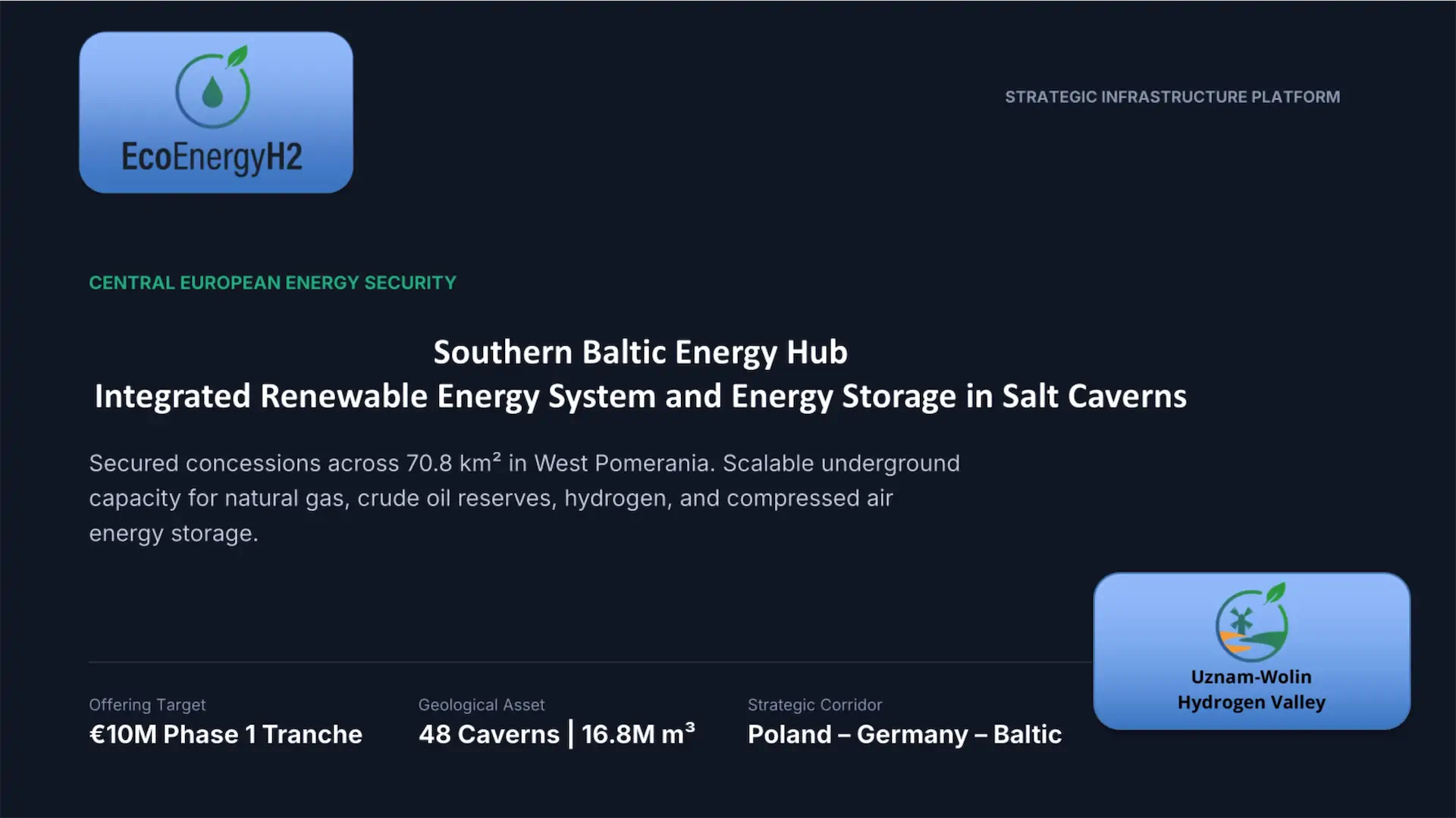
- Capacity scalability: up to 48 caverns with a total designed geometric volume of approximately 16.8 million m³, providing – depending on the intended use – the potential for large-scale storage of hydrogen, compressed air and other energy media.
- High investment scalability (up to EUR 3.8 billion of planned investments with the possibility of staging);
- Clearly defined stages of work implementation and financing;
- Unique strategic location of a dual-site hydrogen and energy hub:
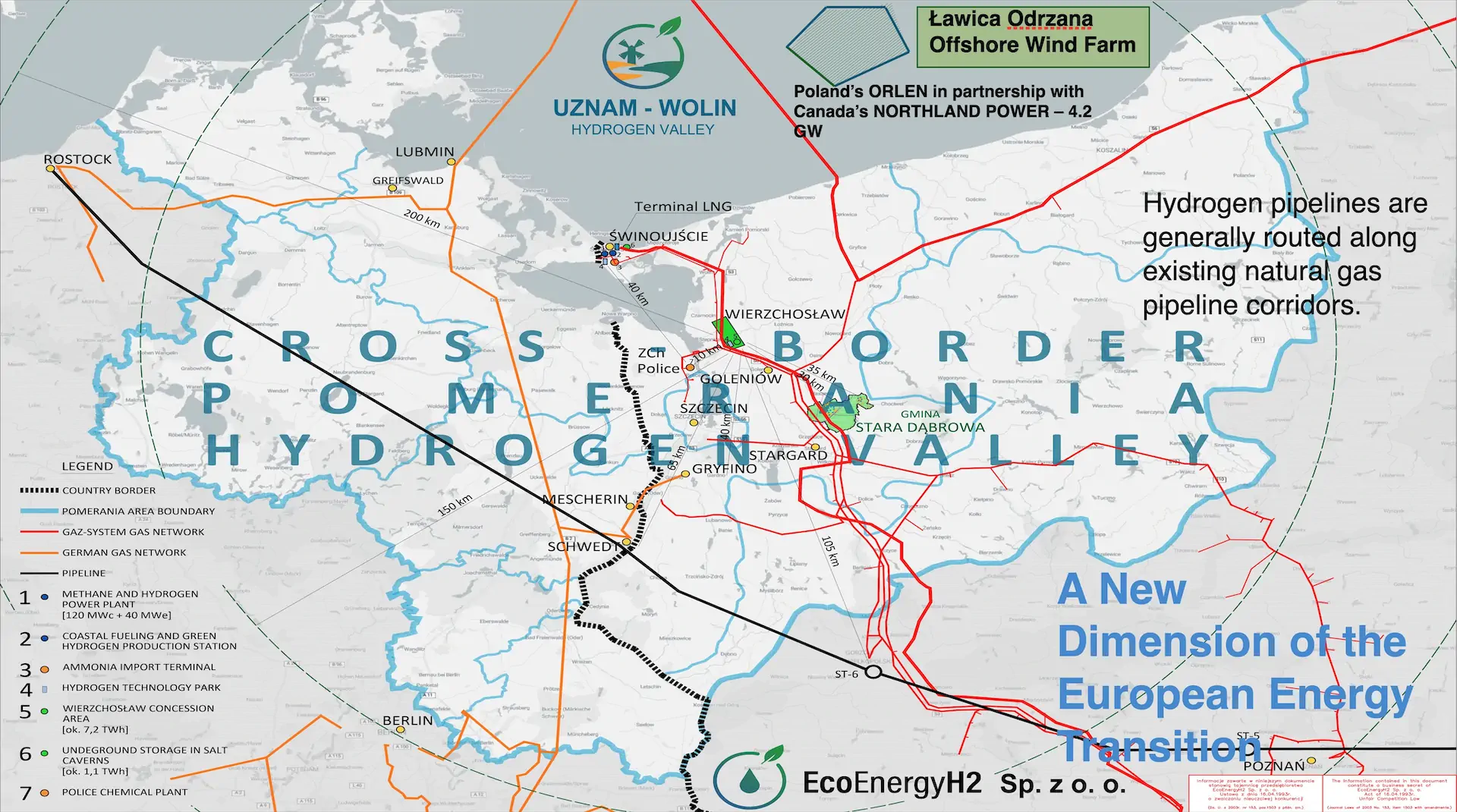
- Location 1 – approximately 6 km from the LNG Terminal in Świnoujście (near the main transmission network of approximately 10 billion m³ of natural gas per year from the LNG terminal);
- Location 2 – at a distance of:
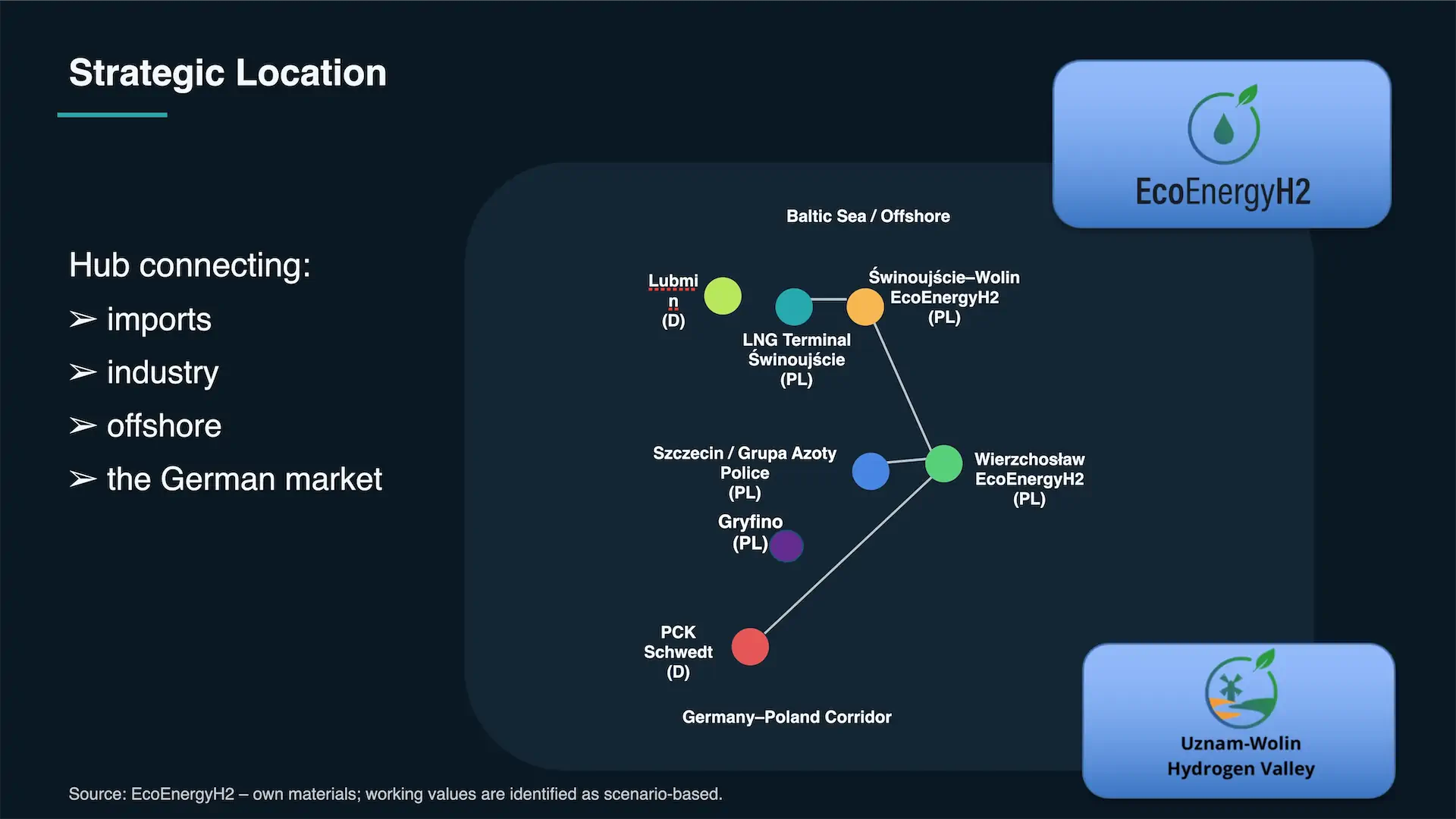
- approx. 100 km from the last compressor station ST6 of the Druzhba pipeline on the Polish side (connection with the Northern Port and the ORLEN Refinery in Płock from the Polish side and with the PCK Schwedt refinery from the German side and, among others, with the Port of Rostock)
- about 10 km from Zch Police;
- approx. 40 km from Gryfino;
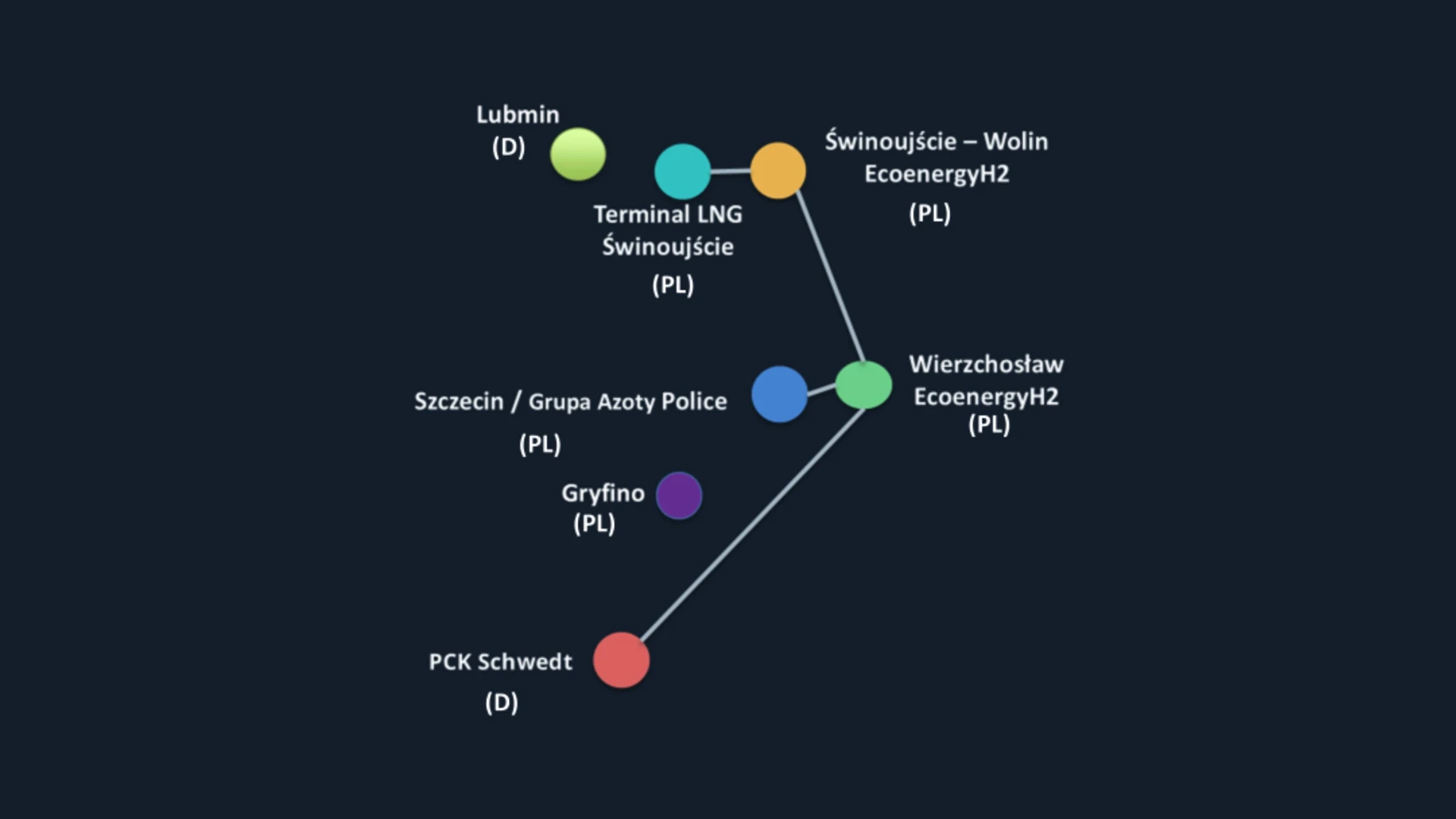
- 70 km from the PCK Schwedt Refinery (Germany) and cross-border connections, the planned hydrogen and crude oil corridor connecting Poland, Germany and the EU.
EcoEnergyH2 fills the gap that currently exists in the scope of large-scale hydrogen storage infrastructure and system flexibility in the BEMIP hydrogen corridor, creating a scalable hydrogen storage node in salt caverns, strategically located at the interface of the Pomeranian Green Hydrogen Cluster, the Nordic-Baltic Hydrogen Corridor, the Baltic Sea Hydrogen Collector and the Polish-German hydrogen market.
The project is intended to help absorb energy from renewable sources when the transmission grid is unable to accept and transmit it. This suggests a similar argument that EcoEnergyH2 could use for its project: Baltic offshore wind → surplus energy → network limitations → CAES in caverns → energy release at the peak.
Stage I
It would provide approximately 0.66–0.88 TWh of working hydrogen storage capacity, with the project scalable to approximately 2.64 TWh at the Świnoujście–Wolin location and to approximately 10.56 TWh of combined storage potential across both EcoEnergyH2 concession areas.
At the same time, the EEH2 project can therefore be described as:
scalable to 2.64 TWh of storage capacity in Świnoujście/Wolin and to approximately 10.5 TWh in total in the area of two EcoEnergyH2 licenses, i.e. with the current EcoEnergyH2 assumptions:
- Świnoujście/Wolin
12 caverns × approx. 0.22 TWh H₂ = approx. 2.64 TWh - Wierzchosław
36 caverns × approx. 0.22 TWh H₂ = approx. 7.92 TWh - together
48 caverns = ok. 10.56 TWh
Ultimately, approximately 0.8–1.7 GWh of usable electricity storage capacity can be assumed for one cavern with a volume of 350,000 m³, depending on the cavern depth, permissible operating pressure range and the final technological configuration of the CAES system.
The second EU PCI/PMI list in the Baltic Sea region in the BEMIP area
Before the hydrogen economy reaches full maturity, it is necessary to solve the most important problem of the energy transition – ensuring the stable integration of renewable energy into national power systems.
This means the need to build large-scale energy storage facilities that will allow for the utilization of surplus energy from offshore and onshore wind farms instead of limiting their production.
The most effective solution will be the use of salt caverns, adapted for the purpose of hydrogen storage, for storing energy, first of all also in the form of compressed air (CAES), and then, ultimately – as the market develops – also hydrogen.
This solution will enable the stabilization of the power system, increase the use of renewable energy sources, and reduce the phenomenon of curtailment and will contribute to reducing the costs of green hydrogen production by ensuring greater availability of cheap electricity for electrolysers.
Ultimately, the same caverns, as underground storage facilities (depth from the ground surface: from -800 m to -2000 m) will be able to function as multifunctional strategic storage facilities, adapted to the current market needs and energy security, enabling the storage of natural gas and crude oil, and in the transition period also compressed air and ultimately hydrogen.
There is no project on the 2nd list that would combine in one project on such a scale as EcoEnergyH2: new salt caverns, H storage₂, offshore wind integration, potential CAES, H production₂, port location and at the same time Polish-German cross-border function.
The second EU PCI/PMI list establishes the main hydrogen transport corridors in the Baltic Sea region in the BEMIP area:
- Nordic-Baltic Hydrogen Corridor,
- Baltic Sea Hydrogen Collector,
- Pomeranian Green Hydrogen Cluster,
However, it does not include any PCI project for large-scale hydrogen storage within the BEMIP hydrogen corridor; there are no clear elements relating to large-scale hydrogen storage, energy system flexibility, and seasonal balancing. This means that in the BEMIP corridor, which covers Poland and the Baltic Sea, there is no large-scale H storage project on the second list.₂. And at the same time, there are huge transmission projects there. This creates a very logical infrastructure gap: H production₂ → exists, offshore / renewable energy → there is a pipeline Finland–Baltic–Poland–Germany → planned Poland-Germany pipeline → planned, Baltic Sea Hydrogen Collector → planned, large-scale underground H₂ storage in the BEMIP region → no PCI.
This existing structural gap in system flexibility can be filled by EcoEnergyH2 caverns as a Baltic hydrogen storage and balancing hub (Baltischer Hub für Wasserstoffspeicherung und Systemausgleich; or Baltic hydrogen storage and balancing hub) for hydrogen produced in the Baltic region, rather than solely as a local storage facility, which is the single strongest strategic argument for EcoEnergyH2.
In connection with the preparation of the project for the European PCI/PMI procedure, the company requested support for this project from, among others, the German Federal Ministry of Economic Affairs and Energy (BMWE).
In September 2026, the company received from BMWE Letter of support for the project „EcoEnergyH2 Baltic Hydrogen Storage – West Pomerania” as a Project of Common Interest (PCI). This letter expresses, on behalf of the German Federal Ministry of Economic Affairs and Energy, further support for the application of the project „EcoEnergyH2 Baltic Hydrogen Storage – West Pomerania” for recognition as a European Project of Common Interest (PCI).